
Memory
You watch your child study for a test, carefully reading, repeating, even understanding—and then the next day, it’s as if the learning has vanished. Or you watch your child painstakingly sound out a word, only not to recognize it a few sentences later.
It can feel confusing, even discouraging. But what if the issue isn’t effort or ability, but how memory actually works?
Types of Memory
Memory isn’t just one system—it’s a set of interconnected processes that handle information in different ways. Sensory memory briefly holds what we see, hear, or feel for just seconds. Working memory (often called short-term memory) is what we use to hold and manipulate information in the moment, like following directions or doing mental math. Over time, important information can move into long-term memory, where it’s stored more permanently. Long-term memory itself includes different types, such as declarative memory (facts and events we can talk about) and procedural memory (skills we perform automatically, like riding a bike). Understanding these systems helps explain why some things “stick” while others fade quickly.
Within working memory, there are 2 types of memory systems. Verbal working memory helps us hang on to information we hear (auditory information) long enough to use it. Nonverbal working memory helps us hang on to visual and spatial information.
Verbal Working Memory

Symptoms of poor verbal working memory
Following multi-step directions
They may remember the first part of an instruction but lose the rest (e.g., “Get your book, turn to page 12, and underline the title”).
Sounding out words when reading
Blending sounds together is harder because they can’t hold each sound long enough (e.g., /c/…/a/…/t/ doesn’t easily become cat).
Reading comprehension
They may decode the words but forget what they read by the end of the sentence or paragraph.
Spelling and writing
Holding a word in mind while writing it down can be difficult, leading to omissions or letter order errors.
Learning new vocabulary
New words may not “stick” because they fade before being fully processed.
Mental math
Keeping numbers in mind while solving a problem (e.g., carrying or multi-step calculations) is especially challenging.
Note-taking or copying from the board
They may lose track of what they’re trying to write before they finish.
Participating in conversations
They might forget what they wanted to say or have trouble keeping up with fast-paced verbal exchanges.
Nonverbal Working Memory
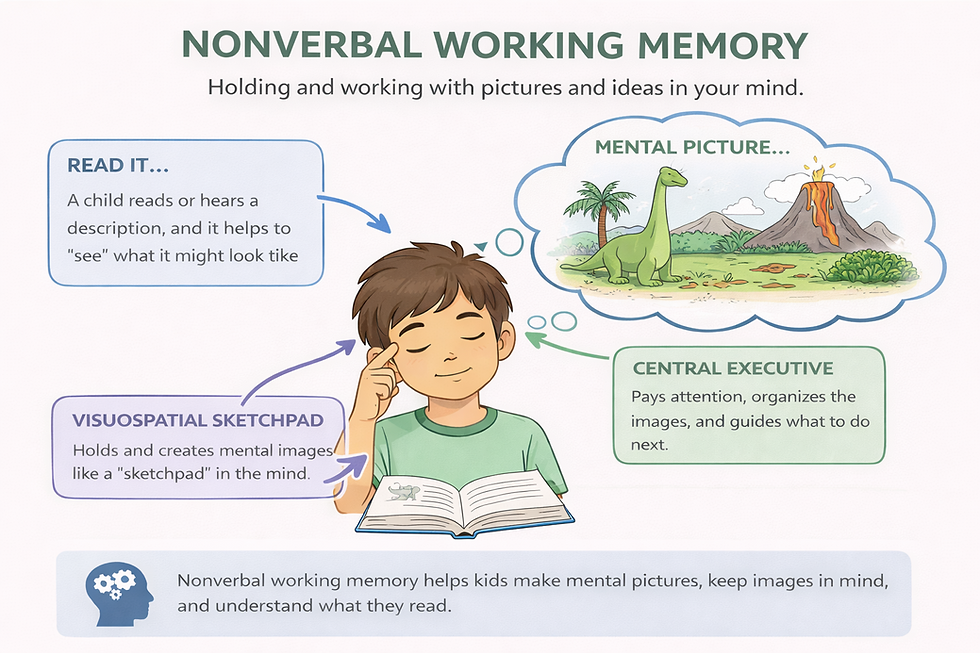
Symptoms of poor nonverbal working memory:
Difficulty with reading comprehension (especially visualization)
The child may read the words accurately but struggle to “picture” what’s happening, making it harder to understand descriptions, sequences, or infer meaning.
Challenges in math (especially multi-step or visual problems)
Tasks like aligning numbers, understanding place value, geometry, graphs, or word problems can be difficult because they require holding visual information in mind.
Trouble copying or organizing written work
Copying from the board, spacing words, keeping work aligned on a page, or organizing ideas visually (e.g., paragraphs, graphic organizers) may be inconsistent.
Difficulty with patterns and sequences
Recognizing, remembering, or extending visual patterns (e.g., shapes, designs, number patterns) can be hard.
Weakness with maps, charts, and diagrams
Interpreting visual information—like timelines, graphs, or science diagrams—may be confusing or overwhelming.
Difficulty picturing the end goal
The child may not be able to visualize what a finished project, paragraph, or solution should look like, so they don’t know what they’re working toward.
Trouble organizing steps in space and sequence
Even if they know the steps verbally, they may struggle to arrange them in a logical order or keep track of where they are in the process.
There are ways to help!
Helping a child with their literacy goals means supporting their verbal and nonverbal working memory where needed. Find someone who can do more than just help your child complete their homework assignments. Find someone who can address the underlying difficulties and build lifelong skills. SLPs have a broad scope of practice and can identify ways to address your child's individual needs.
Ready to get started?
Contact us today: 778-392-6598 or info@adventuresinspeech.com


Comments